
(As told by Jack, the Storyteller Cat)
My dear friends, you all know by now that I carry upon my whiskers the Herculean task of one day conquering Smores’ heart—or, at the very least, negotiating a peace treaty that allows me to share a sunbeam or two in her esteemed presence.
I am not confrontational. No, no. A gentleman does not duel unless truly obliged. But a cat must, on occasion, stand for himself. And when he does speak, it is never with vulgar noise, but with a touch of literary polish. After all, I am Jack—the Storyteller Cat.

Let me tell you how it went yesterday.
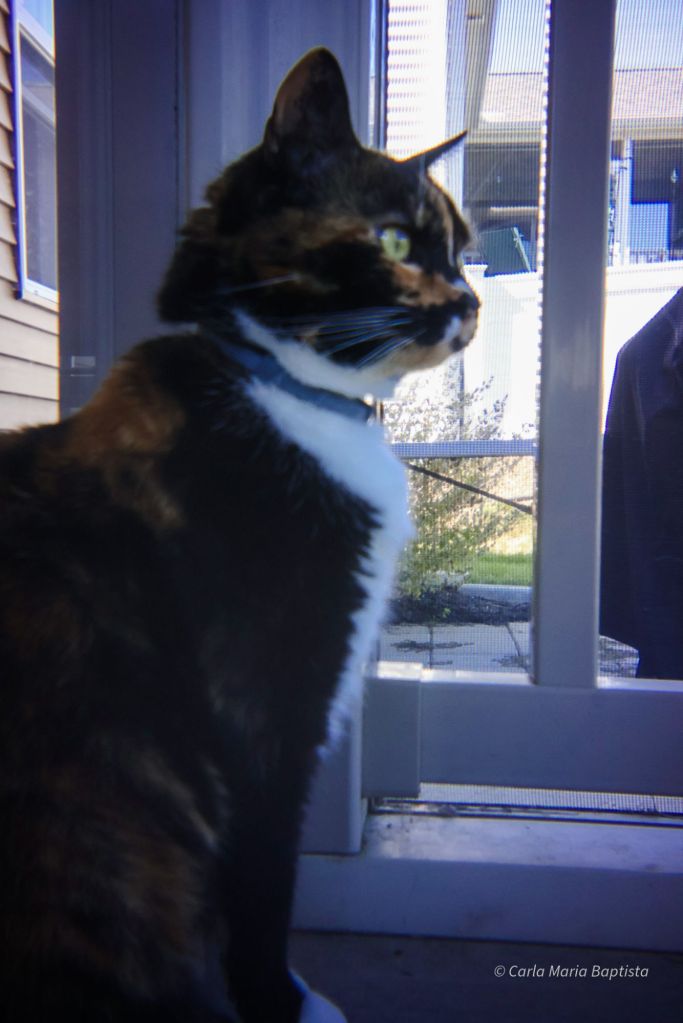
Mommy had just returned home. The door to the fence (you may call it a screen door, but to me it is a barrier most noble) was opened. I was there at my post, recounting the day’s chronicles: the spider who took up residence on the porch last night, the passing of automobiles, the subtle shifting of the wind—matters of great consequence to a cat of observation.
Then Smores appeared.
Ah, Smores. The sun’s chosen child, her fur gilded by the light itself. She approached the bench—pardon me, the fence—with all the deliberate grace of a queen inspecting her court. And then she fixed me with one of those looks. You know the kind. The look that says: You, Jack, are but a minor character in the great opera of my life.
Immediately, I knew I must retreat. A gentleman never quarrels with a lady’s stare. So, in my softest, most dignified tone, I excused myself:
“Forgive me, Smores. I must go see this cat about a sardine…”
Her eyes widened. A sardine? Another cat?! What scandal was this?
“Explain yourself, Jack!” she demanded, her voice equal parts diva and thundercloud.

I adjusted my whiskers, as though tightening a cravat, and replied:
“Well, my dear, it is but an idiom. In English, one goes to see a man about a horse. In Portugal, one says vou ali e já venho—I’m going over there and I’ll be right back. I, being a cat of dual culture and refined tastes, simply adapted the matter to suit our national spirit and our feline appetites. Hence: a sardine.”
She narrowed her eyes. “Hmm. You are the Storyteller Cat. I was expecting something a little more… literary.”
Ah, my friends, and here lies the tragedy of my life: whatever I say, however artfully I embroider my excuses, Smores will always see through me. Yet, is that not what makes her so dazzling? To be dismissed with the elegance of irony, to be tolerated with the faintest yawn, to be allowed, perhaps one day, the honor of a shared cushion—that is my Herculean task.
Until then, whenever Smores casts that look upon me, you may be certain: I shall bow, whisper something grand—perhaps even “Permit me a brief absence: I must attend to a mysterious affair of gentlemen.” (as Eça de Queiroz himself might say)—and retreat with all the dignity of a cat about a sardine.
— Jack 🐾
Smores: “Dignity, sardines, horses… excuses of a cat. Don’t let him fool you, dear readers. I see everything.”
🐾 Whisker Note:
Eça de Queiroz (1845–1900) — Portugal’s master of realism, author of The Maias and The Crime of Father Amaro. Often compared to Balzac and Flaubert, he exposed society’s follies with biting irony and lyrical prose.
Smores: “Balzac, Flaubert… and now Jack thinks he belongs in the same club.”
Uma Sardinha, um Cavalo e uma Certa Diva
(Contado por Jack, o Gato Contador de Histórias)
Meus caros amigos, todos vós já sabeis que carrego sobre os meus bigodes a tarefa hercúlea de um dia conquistar o coração da Smores, ou, pelo menos, de negociar um tratado de paz que me permita partilhar um raio de sol na sua nobre presença.
Não sou conflituoso. Longe disso. Um cavalheiro não entea em duelos, a não ser que seja absolutamente necessário. Mas, de vez em quando, um gato tem de se afirmar. E quando falo, nunca é com vulgaridade: é sempre com um certo verniz literário. Afinal, sou Jack—o Gato Contador de Histórias.

Deixem-me contar-vos o que aconteceu ontem.
A Mamã tinha acabado de chegar a casa. A porta para a vedação (chamem-lhe porta de rede, se quiserem, mas para mim é uma barreira muito nobre) estava aberta. Eu encontrava-me no meu posto, a relatar as crónicas do dia: a aranha que se instalou no alpendre durante a noite, os carros que passaram, a brisa que mudava de rumo, enfim, assuntos de grande importância para um gato observador.
E eis que aparece a Smores.
Ah, Smores. A filha escolhida do sol, o pêlo dourado pela própria luz. Aproximou-se da tribuna, desculpem da vedação, bem, não importa, com a graça deliberada de uma rainha a inspeccionar a sua corte. E então lançou-me aquele olhar. Sabem qual. O olhar que diz: Tu, Jack, és apenas uma nota de rodapé na grande ópera da minha vida.
Nesse instante, percebi que tinha de recuar. Um cavalheiro nunca discute com o olhar de uma dama. Assim, no tom mais suave e digno que encontrei, desculpei-me:
“Perdoa-me, Smores. Tenho de ir ver este gato sobre uma sardinha…”
Os olhos dela arregalaram-se. Uma sardinha? Outro gato?! Que escândalo era este?
“Explica-te, Jack!” exigiu, a sua voz a meio caminho entre diva e trovão.

Endireitei os bigodes, como quem ajeita uma gravata, e respondi:
“Minha querida, é apenas uma frase idiomática. Em inglês, vai-se ver um homem sobre um cavalo. Em Portugal, diz-se vou ali e já venho. Eu, sendo um gato de dupla cultura e gostos refinados, adaptei a expressão ao nosso espírito nacional e ao apetite felino. Daí: uma sardinha.”
Ela semicerrrou os olhos. “Hmm. Tu és o Gato Contador de Histórias. Esperava algo mais… literário.”
Ah, meus amigos, eis aqui a tragédia da minha vida: por mais que eu diga, por mais que adorne as minhas desculpas, a Smores há de sempre ver através de mim. Mas não será precisamente isso que a torna tão deslumbrante? Ser rejeitado com a elegância da ironia, ser tolerado com o mais leve dos bocejos, talvez um dia receber a honra de partilhar uma almofada, esta é a minha tarefa hercúlea.

Até lá, sempre que a Smores me lança aquele olhar, podem estar certos: eu hei de inclinar-me, murmurar algo grandioso, talvez até “Permita-me uma breve ausência: devo atender a um misterioso assunto de cavalheiros” (como diria o próprio Eça de Queiroz) e recuar com toda a dignidade de um gato acerca de uma sardinha.
— Jack 🐾
Smores: “Dignidade, sardinhas, cavalos… desculpas de gato. Não se deixem enganar, meus queridos leitores. Eu vejo tudo.”
🐾 Nota de Bigodes:
Eça de Queiroz (1845–1900) — mestre do realismo em Portugal, autor de Os Maias e O Crime do Padre Amaro. Frequentemente comparado a Balzac e Flaubert, expôs as fraquezas da sociedade com ironia mordaz e uma prosa lírica.
Smores: “Balzac, Flaubert… e agora o Jack acha que também faz parte do clube.”


 A Toast Between Seasons